 11
11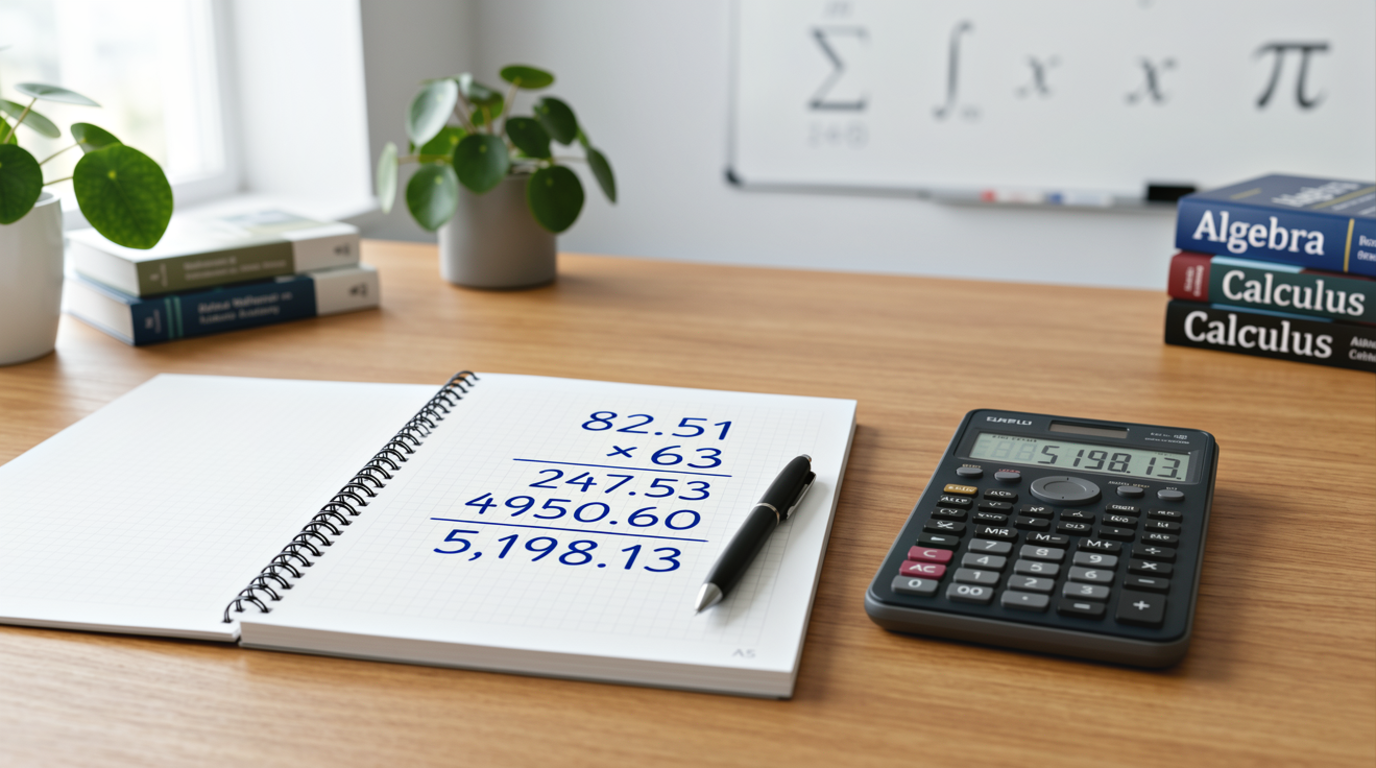
The expression 82.51×63 is most naturally read as 82.51 multiplied by 63. In standard mathematical notation, it would usually be written as 82.51 × 63. The letter-like “x” is commonly used as a multiplication symbol when people type calculations online, in messages, spreadsheets, notes, or search boxes.
The first number, 82.51, contains two decimal places, while 63 is a whole number. Multiplying them produces a result that also has two decimal places: 5,198.13.
The answer to 82.51 × 63 is 5,198.13. You can verify the result by breaking 63 into 60 and 3, multiplying 82.51 by each part, and then adding the two results together.
The calculation is:
82.51 × 63 = 82.51 × 60 + 82.51 × 3
That gives:
4,950.60 + 247.53 = 5,198.13
So, the final answer is 5,198.13.
A simple way to solve 82.51×63 is to separate 63 into smaller numbers. Since 63 equals 60 + 3, the multiplication becomes easier to manage without a calculator.
First, multiply 82.51 by 60. Multiplying by 6 gives 495.06, and multiplying that by 10 gives 4,950.60.
Next, multiply 82.51 by 3. The result is 247.53.
Finally, add the two results. 4,950.60 + 247.53 = 5,198.13. This method is quick, easy to check, and useful when you want to understand where the answer comes from.
The decimal point in 82.51 is important because 82.51 is not the same value as 82 or 83. It represents 82 whole units plus 51 hundredths. When you multiply it by 63, those hundredths are carried through the calculation.
For example, multiplying 82 by 63 gives 5,166, while multiplying 83 by 63 gives 5,229. The correct answer, 5,198.13, falls between those two values, which provides a useful quick check.
Estimation can help you spot obvious calculation mistakes. Since 82.51 is slightly greater than 82 and 63 is close to 60, you would expect the answer to be somewhere around 4,900 to 5,200.
A more precise estimate is possible by using 82.5 × 63. That gives 5,197.5, which is very close to the exact answer of 5,198.13. The small difference makes sense because 82.51 is just 0.01 greater than 82.5.
Sometimes a multiplication expression is not simply a school mathematics question. A number such as 82.51×63 can represent two dimensions, a rate multiplied by a quantity, an area calculation, or another practical measurement.
The meaning depends entirely on the context. For example, if 82.51 represents a price per unit and 63 represents the number of units, the result could represent a total cost of 5,198.13 units of currency. If 82.51 represents a measurement and 63 represents another measurement, the multiplication could be used to calculate an area or another quantity.
The numbers alone do not establish the unit. You need the original context to know whether the result is square units, dollars, kilograms, points, or something else.
It can be, but not automatically. If 82.51 and 63 are the length and width of a rectangular object, then multiplying them gives its area. In that situation, the answer would be 5,198.13 square units.
For example, if the dimensions were 82.51 feet by 63 feet, the area would be 5,198.13 square feet. If the dimensions were measured in inches, the result would be 5,198.13 square inches instead.
This is why units should always be included when a multiplication problem relates to physical measurements.
A multiplication such as 82.51 × 63 can appear in many ordinary situations. Someone might use it to calculate the total cost of 63 items priced at 82.51 each, estimate the value of a repeated service, calculate the surface area of a rectangular space, or work out a total based on a fixed rate.
For example, if a service costs $82.51 per session and someone purchases 63 sessions, the basic multiplication would be 82.51 × 63 = 5,198.13. Any taxes, discounts, fees, or additional charges would then need to be handled separately.
Rounding can make calculations faster, but it changes the result slightly. If you round 82.51 to 83 before multiplying by 63, you get 5,229 instead of the exact result of 5,198.13.
That difference is 30.87, which may or may not matter depending on the purpose of the calculation. For casual estimation, rounding can be perfectly reasonable. For invoices, measurements, financial records, or technical work, keeping the original decimal value is usually preferable.
The exact result of 82.51×63 is 5,198.13. An estimated result would depend on how aggressively you round the numbers before calculating.
For example, rounding 82.51 to 82.5 produces 5,197.5, while rounding it to 83 produces 5,229. These estimates can be useful for mental math, but neither replaces the exact calculation when precision is required.
You do not need a calculator to solve this expression. One convenient approach is to multiply 82.51 by 60 and then by 3.
The first calculation is 82.51 × 60 = 4,950.60. The second is 82.51 × 3 = 247.53. Adding these gives 5,198.13.
Another method is to treat 82.51 as 8,251 hundredths. You can multiply 8,251 by 63 to get 519,813, then move the decimal point two places to the left. The result is again 5,198.13.
Breaking a multiplication problem into smaller parts is based on the distributive property of multiplication. Instead of calculating 82.51 × 63 in one step, you can rewrite 63 as 60 + 3.
That means 82.51 × (60 + 3) becomes (82.51 × 60) + (82.51 × 3). The mathematical value stays exactly the same, but the calculation becomes easier to follow and verify.
This approach is especially useful when working with decimals because it reduces the chance of losing track of decimal places.
One common mistake is forgetting the decimal point and treating 82.51 as 8,251. Another is multiplying by 63 incorrectly by confusing it with 60 or 30. People can also make errors when adding the intermediate results.
A simple check is to compare the answer with a rough estimate. Since 82.51 is a little over 82 and 63 is a little over 60, an answer around 5,200 makes sense. A result such as 519.813 or 51,981.3 should immediately look suspicious.
The intermediate calculation 82.51 × 60 equals 4,950.60. This is useful because 63 can be separated into 60 and 3.
When multiplying by 60, you can first multiply 82.51 by 6 to get 495.06 and then multiply by 10. The result is 4,950.60.
The second intermediate calculation is straightforward. 82.51 × 3 = 247.53.
Adding this to 4,950.60 gives the complete answer: 5,198.13.
Yes. Search terms and typed expressions do not always have a single meaning. While 82.51×63 clearly works as a multiplication expression, the same characters could potentially appear as a product code, dimension, reference number, model designation, or other identifier in a particular context.
If you found the term on a product page, document, label, spreadsheet, or technical specification, the surrounding information matters. Without that context, the safest mathematical interpretation is 82.51 × 63.
Numeric search terms can be surprisingly ambiguous. A person searching for a string of numbers may want a calculation, a conversion, an identification, or an explanation of where the number came from.
That is why it is useful to distinguish the mathematical interpretation from other possible meanings. In this case, when the “x” is intended as a multiplication symbol, the answer is clear: 5,198.13.
If 82.51 represents a price and 63 represents a quantity, the multiplication provides a basic subtotal. For instance, 63 units at 82.51 each would cost 5,198.13 before taxes, shipping, discounts, or other charges.
This distinction matters in real-world calculations. The multiplication result is only the starting point if additional costs or reductions apply. Always check whether the original amount includes tax, fees, or other adjustments.
If 82.51 and 63 are dimensions of a rectangle, multiplication gives the rectangular area. The calculation is 82.51 × 63 = 5,198.13.
The unit must be squared in an area calculation. So, dimensions measured in meters would produce 5,198.13 square meters, while dimensions measured in feet would produce 5,198.13 square feet.
When 82.51×63 is intended as a multiplication expression, the calculation is simple:
82.51 × 63 = 5,198.13
The result can be reached directly with a calculator or manually by splitting 63 into 60 and 3. If the numbers represent dimensions, prices, quantities, or another real-world measurement, the surrounding context determines what the final number actually represents. The mathematics, however, remains the same: 5,198.13.
82.51×63 equals 5,198.13 when “x” represents multiplication. The calculation is 82.51 multiplied by 63.
Split 63 into 60 and 3. Calculate 82.51 × 60 = 4,950.60 and 82.51 × 3 = 247.53, then add them to get 5,198.13.
Yes. Assuming the expression means 82.51 multiplied by 63, 5,198.13 is the exact result.
Yes, if 82.51 and 63 are the length and width of a rectangular space or object. The result is 5,198.13 square units.
Rounding changes the result. For example, rounding 82.51 to 83 gives 5,229 when multiplied by 63. For precise work, use the original value.
82.51 × 60 = 4,950.60. This is one of the two intermediate calculations used to solve 82.51 × 63.
82.51 × 3 = 247.53. Adding this to 4,950.60 produces the final result of 5,198.13.
Read also: BN6922297R Samsung TV Code and Part Guide