 11
11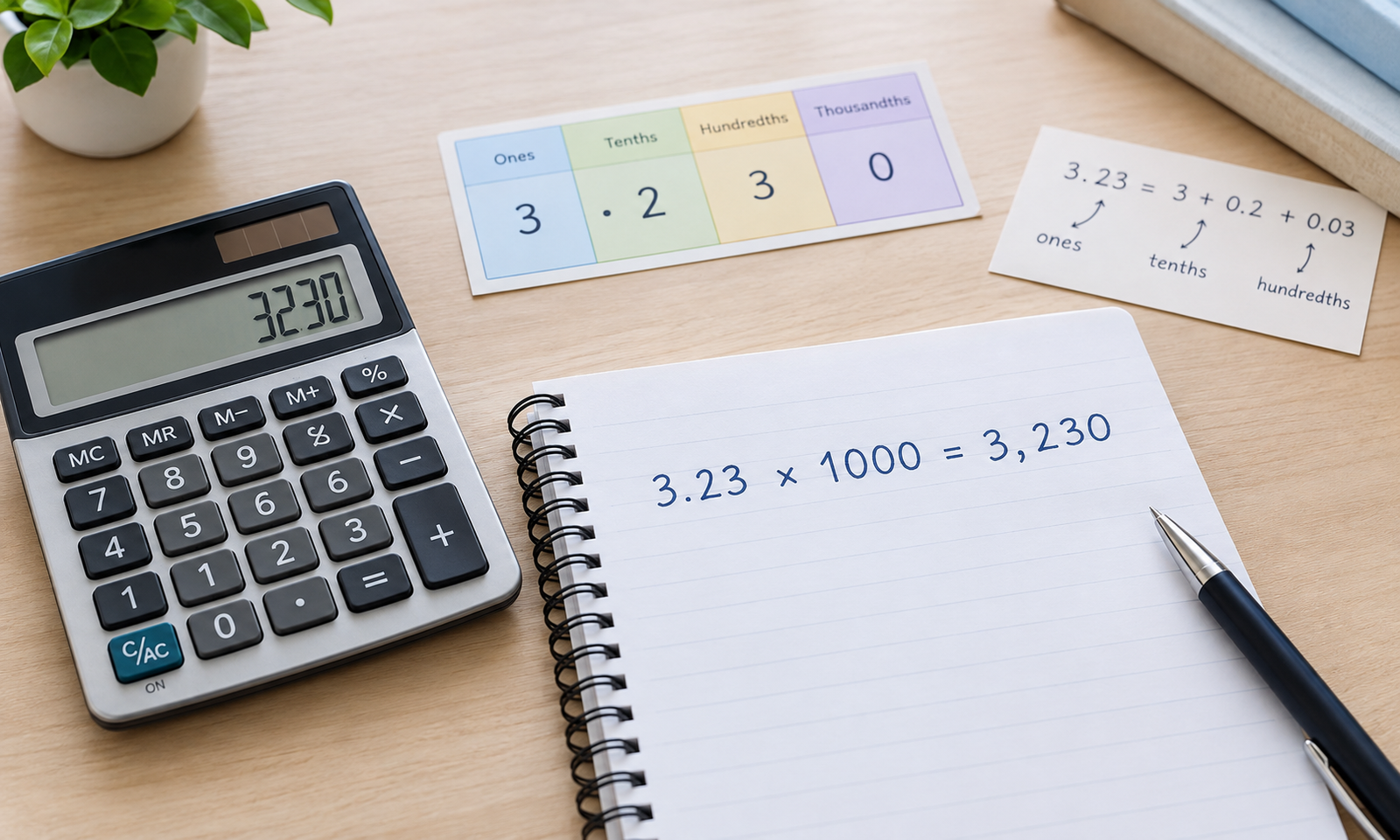
Learn what 3.23×1000 means, see the exact answer, and discover the simple decimal-point method used to solve this calculation quickly. 3.23×1000 means 3.23 multiplied by 1,000. The letter “x” is commonly used as a multiplication symbol, so the expression can also be written as 3.23 × 1,000. Because 1,000 contains three zeros, multiplying 3.23 by it shifts the decimal point three positions to the right. The final result is 3,230.
The answer to 3.23×1000 is 3,230. You can calculate it by multiplying 3.23 by 10 first, then by 100, and finally by 1,000. Another quick method is to move the decimal point three places to the right: 3.23 → 32.3 → 323 → 3,230. This method is especially useful when working with powers of ten.
Calculating 3.23 × 1000 does not require a calculator. Start with the number 3.23 and identify its decimal point. Since you are multiplying by 1,000, move that decimal point three places to the right. After one move, the number becomes 32.3; after two moves, it becomes 323; and after the third move, it becomes 3,230.
A useful math rule is that multiplying a decimal by 10, 100, or 1,000 moves the decimal point to the right. The number of places depends on the number of zeros. Multiplying by 10 moves it one place, multiplying by 100 moves it two places, and multiplying by 1,000 moves it three places. This makes expressions such as 3.23×1000 quick to solve.
The decimal moves because multiplying by a power of ten increases the place value of every digit. In 3.23, the 3 is in the ones place, while the 2 and 3 represent tenths and hundredths. Multiplying by 1,000 increases each place value by three positions. As a result, 3.23 becomes 3,230.
You can understand the calculation by breaking 1,000 into smaller multiplication steps. For example, 3.23 × 10 equals 32.3, and 32.3 × 10 equals 323. Multiplying 323 by another 10 gives 3,230. Since 10 × 10 × 10 equals 1,000, the result is the same as calculating 3.23 × 1,000 directly.
In many contexts, 3.23K represents 3,230, because “K” is commonly used as an abbreviation for one thousand. However, the two expressions serve different purposes. 3.23 × 1,000 is a mathematical multiplication problem, while 3.23K is generally a shorthand way of writing 3,230. You may see this abbreviation in statistics, social media figures, business reports, or other numerical displays.
An expression like 3.23×1000 can appear in many situations. Someone might use it in a math exercise, spreadsheet, financial calculation, measurement conversion, school assignment, or online calculator search. The exact context can change what the number represents, but if the expression is strictly a multiplication problem, the mathematical result remains 3,230.
Imagine a business has 3.23 units of something measured in thousands. Multiplying 3.23 by 1,000 converts that figure into individual units, giving 3,230 units. The same principle can apply to money, quantities, distances, or other measurements when the original value is expressed using thousands. The important point is to understand what the original unit represents before interpreting the final number.
If a report lists an amount as 3.23 thousand dollars, multiplying 3.23 by 1,000 converts it into 3,230 dollars. The arithmetic is simple, but the unit matters. Without knowing whether the original figure refers to dollars, products, people, or another quantity, the number alone does not tell you what the 3,230 represents.
Suppose a warehouse report states that a product quantity is 3.23 thousand units. Converting that figure into individual units requires multiplying by 1,000. The result is 3,230 units. This is a common reason decimal numbers and thousands are multiplied in business and inventory reporting.
One common mistake is moving the decimal point too few or too many places. Because 1,000 has three zeros, the decimal needs to move exactly three places to the right. Another mistake is writing 323 instead of 3,230. Remember that 3.23 contains a whole-number portion, and moving the decimal three places produces a number in the thousands.
When any decimal number is multiplied by 1,000, its decimal point moves three places to the right. For example, 1.5 becomes 1,500, 2.75 becomes 2,750, and 4.125 becomes 4,125. The same rule applies to 3.23, giving 3,230. This shortcut works because 1,000 is a power of ten.
Multiplication and division produce very different results. While 3.23 × 1,000 = 3,230, dividing 3.23 by 1,000 gives 0.00323. Multiplication by 1,000 moves the decimal three places to the right, while division by 1,000 moves it three places to the left. Checking the operation sign is therefore important before calculating.
A simple way to verify 3.23 × 1,000 = 3,230 is to divide the result by 1,000. If 3,230 ÷ 1,000 gives 3.23, the original multiplication is correct. You can also estimate the answer: 3.23 is slightly greater than 3, and multiplying a number around 3 by 1,000 should produce a number around 3,000. That makes 3,230 a reasonable result.
The calculation looks more complicated than it really is because the decimal number is written next to a large number. In reality, multiplying by 1,000 follows one of the simplest place-value rules in mathematics. Once you recognize that 1,000 is a power of ten, you can solve the expression almost instantly without performing traditional long multiplication.
Place value is the key to understanding this calculation. In 3.23, the digits represent 3 ones, 2 tenths, and 3 hundredths. When the number is multiplied by 1,000, each digit moves three place values to the left in terms of its numerical position. The result is 3,230, where the digits now represent thousands, hundreds, and tens.
Yes, you can enter 3.23 × 1000 into virtually any basic calculator and receive 3,230. However, a calculator is not necessary for this particular expression. Learning the decimal-point rule is often faster and helps you solve similar calculations mentally. It is especially handy when dealing with multiples of 10, 100, and 1,000.
The final answer is 3,230. The expression 3.23×1000 simply asks you to multiply 3.23 by 1,000. Moving the decimal point three places to the right gives 3,230. Once you understand this place-value trick, similar calculations become quick and easy to solve.
3.23×1000 equals 3,230. The expression means 3.23 multiplied by 1,000, and multiplying by 1,000 moves the decimal point three places to the right.
To calculate it, move the decimal point in 3.23 three places to the right. The number changes from 3.23 to 32.3, then 323, and finally 3,230.
No. 3.23 × 1000 equals 3,230, while 3.23 × 100 equals 323. The difference comes from the number of zeros in the multiplier.
3.23 ÷ 1,000 = 0.00323. Division by 1,000 moves the decimal point three places to the left.
In common numerical shorthand, yes. 3.23K generally means 3,230, because K is often used to represent one thousand. The exact meaning can depend on the context.
Read also: Myarsleads.com A Guide to Digital Marketing, SEO, and Lead Generation