 11
11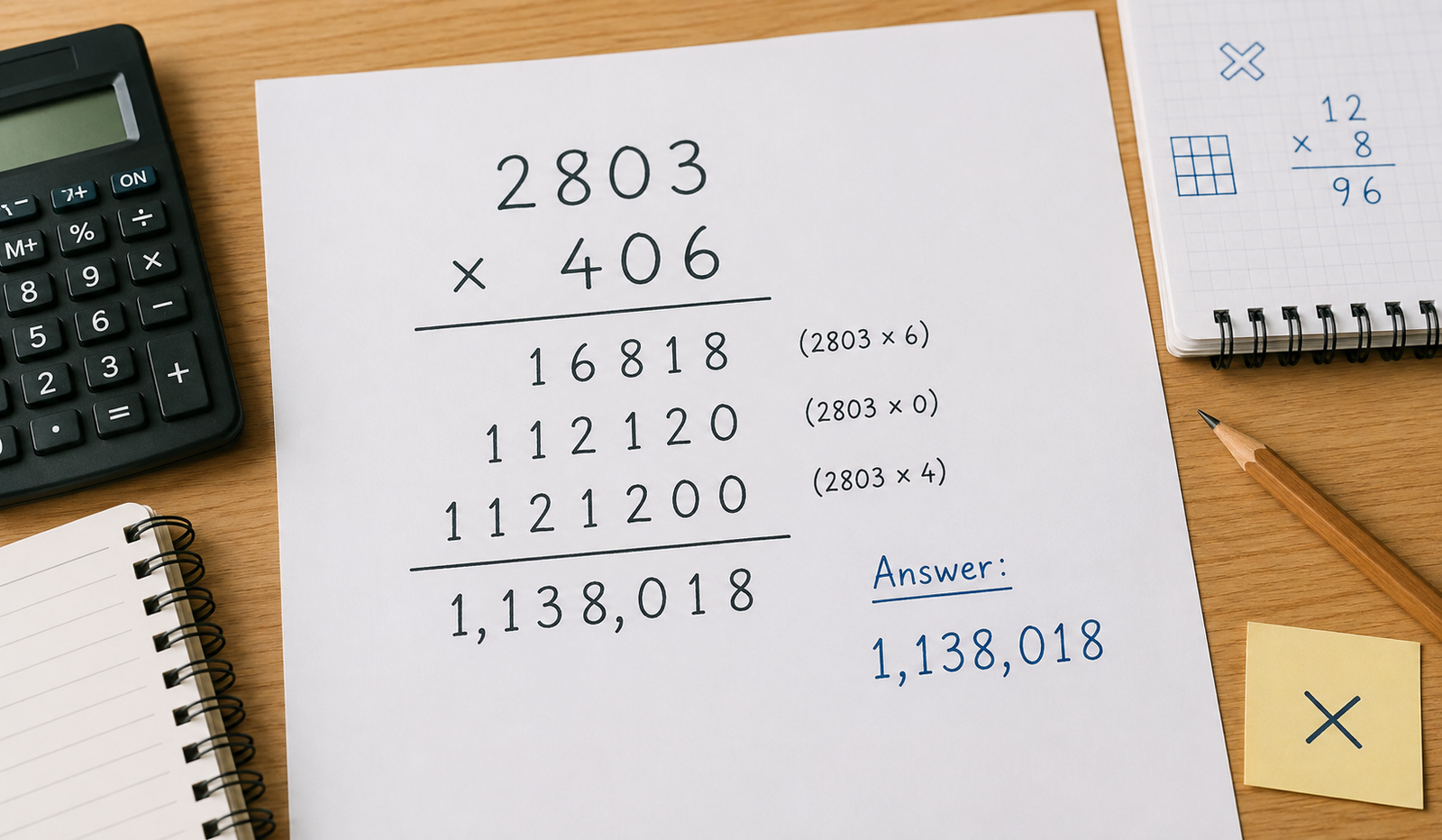
2803×406 is a multiplication problem involving the whole numbers 2,803 and 406. The multiplication sign is sometimes written as an “x,” so 2803×406 simply means 2,803 multiplied by 406. When these two numbers are multiplied, the result is 1,138,018. This type of problem is commonly used in elementary and middle-school mathematics to practice multiplying multi-digit whole numbers and checking an answer through estimation.
The answer to 2803 × 406 is 1,138,018. The easiest way to understand the calculation is to split 406 into 400 and 6. First multiply 2,803 by 400, which gives 1,121,200. Then multiply 2,803 by 6, which gives 16,818. Adding those two results gives 1,138,018. This method is especially useful when you want to understand where every part of the final number comes from instead of relying only on a calculator.
To solve 2803×406, start by separating 406 according to its place values. The number 406 contains 4 hundreds, 0 tens, and 6 ones, so it can be written as 400 + 6. Now calculate 2,803 × 400, which equals 1,121,200. Next, calculate 2,803 × 6, which equals 16,818. Finally, add 1,121,200 and 16,818 together. The total is 1,138,018. Breaking the problem into these smaller calculations makes the process easier to follow and reduces the chance of a place-value error.
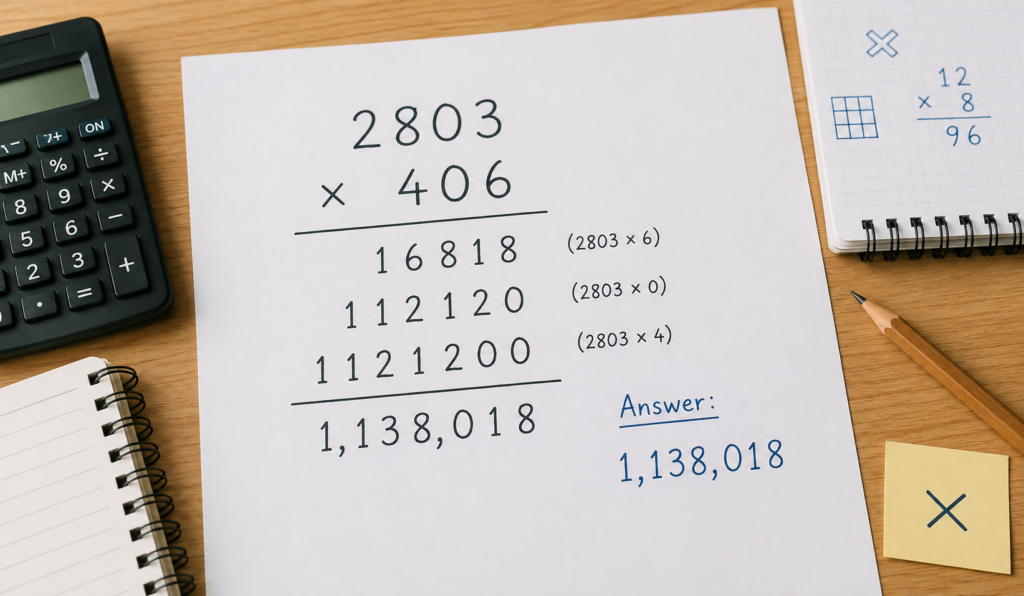
The traditional long-multiplication method produces the same result. Write 2,803 above 406 and begin with the ones digit, which is 6. Multiplying 2,803 by 6 gives 16,818. Next, move to the tens digit. Because the tens digit of 406 is zero, that partial product contributes zero. Finally, multiply 2,803 by 4 in the hundreds position. The result is 11,212, but because the 4 represents 400 rather than 4, the product becomes 1,121,200. Adding the partial products produces 1,138,018.
One of the simplest mental strategies for 2803×406 is to rewrite 406 as 400 + 6. This works because multiplication distributes across addition. In mathematical form, the calculation becomes 2,803 × (400 + 6). You can then solve each part separately and add the results. This approach is often easier than performing every step of traditional long multiplication, especially when working without paper. It also makes it easier to identify an incorrect answer because each intermediate result can be checked independently.
Estimation is useful when solving a multiplication problem because it gives you a rough idea of what the answer should look like. For example, 2,803 is close to 2,800, while 406 is close to 400. Multiplying those rounded values gives approximately 1,120,000. The exact answer, 1,138,018, is reasonably close to that estimate. This quick check tells you that the result is in the right general range. If your calculator or written work produced a number such as 113,801 or 11,380,180, the estimate would immediately suggest that something went wrong.
Place value is one of the most important ideas in this calculation. The 4 in 406 does not mean simply four; it represents four hundred. Likewise, the 8 in 2,803 represents eight hundreds, while the 2 represents two thousands. Losing track of these positions can create a result that is off by a factor of ten or one hundred. When solving 2803×406, always pay attention to where each digit belongs. Keeping the columns aligned is particularly important when using the long-multiplication method.
You can also solve the problem mentally by using a convenient breakdown. Think of 406 as 400 + 6. Then calculate 2,803 × 4 first, giving 11,212, and multiply that result by 100 to get 1,121,200. Next, calculate 2,803 × 6, giving 16,818. Add the two values and you arrive at 1,138,018. This method avoids unnecessary written steps while still keeping the calculation organized. It is especially helpful once you become comfortable working with place values.
A common mistake is forgetting that the 4 in 406 represents 400. Another is incorrectly handling the zero in the tens position. Some people also add the partial products incorrectly after completing the multiplication. Writing the numbers in aligned columns can prevent many of these errors. It is also useful to estimate the answer before doing the exact calculation. If the final number is dramatically different from the estimate, go back and check the multiplication and place values rather than assuming the first result is correct.
A calculator provides a quick way to verify the multiplication. Enter 2803, select multiplication, enter 406, and calculate the result. The display should show 1,138,018. While a calculator is convenient, understanding the manual process is still valuable because it lets you recognize whether a calculator entry was made correctly. For example, accidentally entering 2803 × 46 would produce a completely different result. Knowing the expected size of the answer makes such input mistakes easier to catch.
A problem like 2803×406 teaches more than simply finding a number. It gives students practice with multiplication, place value, estimation, and checking their work. It also demonstrates how a large-looking problem can be simplified by separating numbers into manageable pieces. These skills become useful later when working with measurements, prices, quantities, areas, budgets, and other everyday calculations. Once the basic idea becomes familiar, similar multiplication problems can be solved much more quickly.
The distributive property provides another mathematical explanation for the answer. Since 406 can be expressed as 400 + 6, you can write the calculation as 2,803 × (400 + 6). The expression can then be distributed into two smaller multiplications: (2,803 × 400) + (2,803 × 6). Those products are 1,121,200 and 16,818. Adding them produces 1,138,018. This shows that the shortcut is not just a convenient trick; it follows a fundamental rule of arithmetic.
Although 2803×406 is a straightforward math exercise, multiplication of this type appears in practical situations. Imagine a warehouse has 2,803 items arranged across each of 406 identical units. Multiplication can determine the total number of items without counting each one individually. Similar calculations can appear in inventory management, manufacturing, construction measurements, budgeting, school assignments, and data analysis. The real-world context changes, but the mathematical process remains the same.
You do not need a calculator to check whether 1,138,018 is reasonable. Start with an estimate. Round 2,803 to about 2,800 and 406 to about 400. Their approximate product is 1,120,000. Since the exact answer is 1,138,018, the result is reasonably close to the estimate. You can also perform the multiplication using the alternative breakdown of 406 into 400 + 6. When two independent methods reach the same answer, confidence in the calculation increases.
Yes. Multiplication has a property called the commutative property, which means the order of the factors can be switched without changing the product. Therefore, 2803 × 406 and 406 × 2803 both equal 1,138,018. This is useful when one arrangement makes a written calculation easier to organize. The numbers may appear in a different order, but the final result remains exactly the same.
You may see the same problem written as 2803×406, 2803 × 406, or 2,803 × 406. These forms represent the same mathematical operation. The “x” is often used in plain-text searches because it is easy to type on a keyboard, while the multiplication symbol “×” is more commonly used in polished mathematical writing. Commas may also be added to make large numbers easier to read. Regardless of formatting, the calculation remains the same.
The direct answer is 1,138,018. A simple way to verify it is to split 406 into 400 and 6. Multiply 2,803 by 400 to get 1,121,200, then multiply 2,803 by 6 to get 16,818. Add those products together, and the result is 1,138,018. This method is short enough for a quick answer while still showing the reasoning behind the result.
The calculation 2803×406 may look complicated at first glance, but there is nothing unusual about it. It is simply a multi-digit multiplication problem that becomes easier when you use place value and break the numbers into smaller parts. The exact result is 1,138,018, and both long multiplication and the distributive method lead to the same answer. If you are solving similar problems, remember to estimate first, keep your place values aligned, and check the final result. Those simple habits can make even larger multiplication problems much easier to handle.
2803×406 equals 1,138,018. The expression means that 2,803 is multiplied by 406. You can solve it by using long multiplication or by splitting 406 into 400 and 6.
An easy method is to write 406 as 400 + 6. Then calculate 2,803 × 400 and 2,803 × 6 separately. Add the two products to get 1,138,018.
Yes. The letter “x” is commonly used in plain text to represent the multiplication symbol. Therefore, 2803×406 means 2,803 multiplied by 406.
Yes. Rounding 2,803 to 2,800 and 406 to 400 gives an estimated product of about 1,120,000. This provides a useful check against the exact answer of 1,138,018.
406 × 2,803 is also 1,138,018. Changing the order of the two factors does not change their product because multiplication is commutative.
Read also: The Complete Guide to Alexousa104 and Its Online Meaning